

You can publish brilliant content, earn strong backlinks, and still struggle to rank. Why? Because if search engines can’t crawl, render, or index your pages properly, none of that hard work reaches the results page. That’s the gap technical SEO closes.
Technical SEO focuses on the foundation of your website: how search engines discover, access, understand, and serve your pages. When that foundation is solid, your content has a fair chance to perform. When it’s broken, even great pages can stay invisible.
In this guide, you’ll learn what technical SEO services include, why they matter for search visibility, the most common problems that hold sites back, and how to know when it’s time to bring in professional help. Here’s the roadmap:
- What technical SEO services are and what they cover
- Why technical health affects crawling, indexing, and rankings
- Common issues, a practical audit process, and when to hire experts
What Are Technical SEO Services?
Technical SEO services are professional efforts to improve how search engines crawl, render, index, and interpret a website. They fix issues affecting site speed, mobile usability, indexability, structured data, and site architecture. The goal is a fast, accessible, and technically sound website that supports strong organic search performance.
Think of it as the engineering layer beneath your content strategy. A technical SEO specialist or technical SEO agency diagnoses barriers that stop search engines from properly accessing your pages, then recommends and implements fixes based on data rather than guesswork.
What Do Technical SEO Services Include?
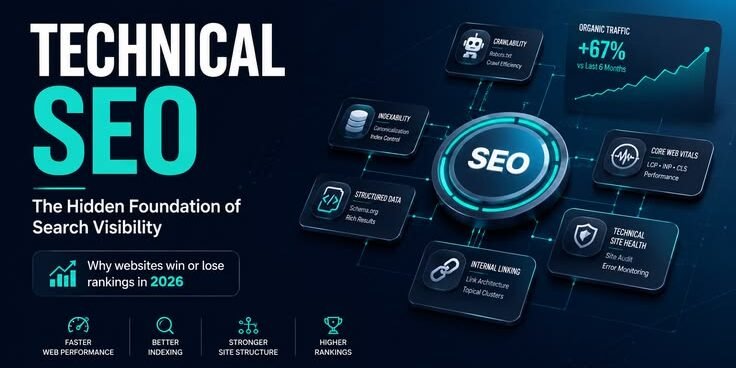
Technical website optimization covers a wide range of areas. Most projects touch several of the following:
- Crawling and crawl efficiency: Making sure search engines can reach important pages without wasting resources on low-value URLs.
- Indexability: Confirming that pages you want ranked are eligible to appear in search results, and that pages you don’t want indexed are excluded.
- Robots.txt: Guiding crawlers on which areas to access or skip, without accidentally blocking key content.
- XML sitemaps: Providing a clean, accurate map of your important URLs so search engines discover them faster.
- Canonical URLs: Signaling the preferred version of a page to prevent duplicate content confusion.
- HTTPS and security: Ensuring your site uses a secure connection, which supports user trust and is a recognized ranking signal.
- Mobile usability: Delivering a smooth experience on phones, since Google indexes the mobile version of most sites.
- Core Web Vitals and page experience: Improving loading, interactivity, and visual stability metrics.
- Site architecture: Organizing pages into a logical structure so both users and crawlers navigate easily.
- Internal linking: Distributing authority and helping search engines understand page relationships.
- Duplicate content: Resolving repeated or near-identical pages that dilute ranking signals.
- Redirects and broken links: Fixing broken paths and cleaning up redirect chains.
- JavaScript SEO: Ensuring content rendered by JavaScript is visible to search engines.
- Structured data (schema markup): Adding markup that helps search engines understand your content and can enable rich results.
- URL structure: Keeping URLs clean, readable, and consistent.
- International SEO: Using hreflang and correct targeting when you serve multiple languages or regions.
A technical SEO audit typically reviews all of these areas and flags what needs attention.
Why Is Technical SEO Important?
Technical SEO matters because it controls whether search engines can find and understand your content in the first place. Discovery, crawling, and indexing all happen before ranking. If a page can’t be crawled or indexed, it simply won’t appear in results, no matter how useful it is.
Consider a common scenario: an online store adds hundreds of new product pages, but a misconfigured robots.txt file blocks the entire product directory. The pages exist, the content is good, but search engines never see them. Sales suffer, and the cause hides in a single line of code.
Technical health also shapes user experience. Slow pages, layout shifts, and poor mobile design frustrate visitors and increase the chance they leave. Since search engines aim to reward satisfying experiences, technical improvements often support both usability and visibility at the same time.
Bottom line: technical SEO doesn’t guarantee rankings, but weak technical foundations can quietly cap your entire performance.
Common Technical SEO Problems
Most websites share a familiar set of issues. Here are the ones a technical SEO consultant sees most often:
- Pages not being indexed: Important pages carry a noindex tag, are blocked, or aren’t discovered.
- Incorrect canonical tags: Canonicals point to the wrong URL, sending confusing signals about which page to rank.
- Broken internal links: Links point to pages that no longer exist, wasting crawl budget and hurting navigation.
- Poor site structure: Key pages sit too many clicks deep, making them hard to reach.
- Duplicate URLs: Parameters, session IDs, or trailing slashes create multiple versions of the same page.
- Slow page performance: Large images, heavy scripts, and slow servers drag down Core Web Vitals.
- Mobile usability problems: Tiny tap targets, unreadable text, or content that overflows the screen.
- Incorrect redirects: Redirect loops, chains, or the wrong redirect type applied.
- Missing or problematic XML sitemaps: Sitemaps that list broken, redirected, or non-indexable URLs.
- JavaScript rendering problems: Content that loads only after user interaction and stays hidden from crawlers.
For example, a media site once saw traffic drop after a redesign. The culprit was a redirect chain from old URLs passing through three hops before landing on the new pages. Cleaning up the chain restored crawl efficiency and helped rankings recover.
How a Technical SEO Audit Works
An SEO technical audit follows a repeatable process. Here’s how a typical one unfolds:
- Crawl the site. Use a crawler to mirror how search engines move through your pages and surface errors at scale.
- Gather diagnostics. Pull data from search performance reports, index coverage, page experience metrics, and server logs where available.
- Identify issues. Group findings into categories such as crawling, indexing, speed, and structure.
- Prioritize by impact. Rank fixes based on how much they affect visibility and effort required. Indexing blockers usually come before minor cosmetic tweaks.
- Implement changes. Apply fixes carefully, often in collaboration with developers.
- Test and validate. Confirm each fix works as intended and doesn’t create new problems.
- Monitor over time. Track crawling, indexing, and performance to measure results and catch regressions.
The right technical SEO solutions always depend on your specific website. What’s urgent for a large ecommerce store may be irrelevant for a small brochure site. If you want an experienced team to run this process for you, a specialist provider such as this technical SEO team can handle diagnostics, prioritization, and implementation.
When Should You Hire Technical SEO Services?
Not every site needs ongoing technical help, but certain situations clearly benefit from professional support:
- Website migrations: Moving domains, changing platforms, or restructuring URLs carries real risk without careful planning.
- Large websites: Sites with thousands of pages face crawl budget and indexing challenges that grow harder to manage manually.
- Ecommerce websites: Faceted navigation, filters, and product variations create duplicate content and crawl issues.
- Declining organic performance: A sudden or steady traffic drop often has a technical root cause.
- Indexing problems: Pages that won’t get indexed, or the wrong pages ranking, signal deeper issues.
- Redesigns: New designs can accidentally break structure, speed, or indexability.
- JavaScript-heavy websites: Modern frameworks need extra care to ensure content renders for search engines.
- Complex site structures: Multiple subdomains, languages, or regions add layers of technical complexity.
If any of these describe your situation, a technical SEO agency can save time and prevent costly mistakes.
Technical SEO Services vs. Other SEO Services
Technical SEO is one pillar of a broader strategy. Here’s how it compares:
- Technical SEO ensures search engines can crawl, render, and index your site.
- On-page SEO optimizes individual pages through titles, headings, and content quality.
- Content SEO creates and improves content that matches search intent.
- Local SEO targets visibility in specific geographic areas and map results.
- Ecommerce SEO focuses on product and category pages for online stores.
- Off-page SEO builds authority through backlinks and mentions.
These work together. Content needs a technically sound site to perform, and a technically perfect site still needs great content to rank. The strongest results come from combining all pillars around your business goals.
Frequently Asked Questions
What does a technical SEO specialist do?
A technical SEO specialist diagnoses and fixes issues affecting crawling, indexing, speed, structure, and rendering. They work with data and often collaborate with developers to implement changes.
What technical SEO issues should I fix first?
Start with anything that blocks indexing or crawling, since those problems prevent pages from ranking at all. Then address site speed, mobile usability, and structure.
How often should a technical SEO audit be performed?
A full audit once or twice a year suits most sites, with lighter monitoring monthly. Large or fast-changing sites may need more frequent reviews.
How much do technical SEO services cost?
Costs vary widely based on site size, complexity, and scope. A one-time audit differs greatly from ongoing support, so pricing should reflect your specific needs.
What is included in a technical SEO audit?
An audit reviews crawling, indexing, site speed, mobile usability, structured data, canonicalization, redirects, internal linking, and site architecture, then delivers prioritized recommendations.
Do technical SEO services guarantee higher rankings?
No credible provider guarantees rankings. Technical work removes barriers and improves your chances, but rankings depend on many factors, including content and competition.