
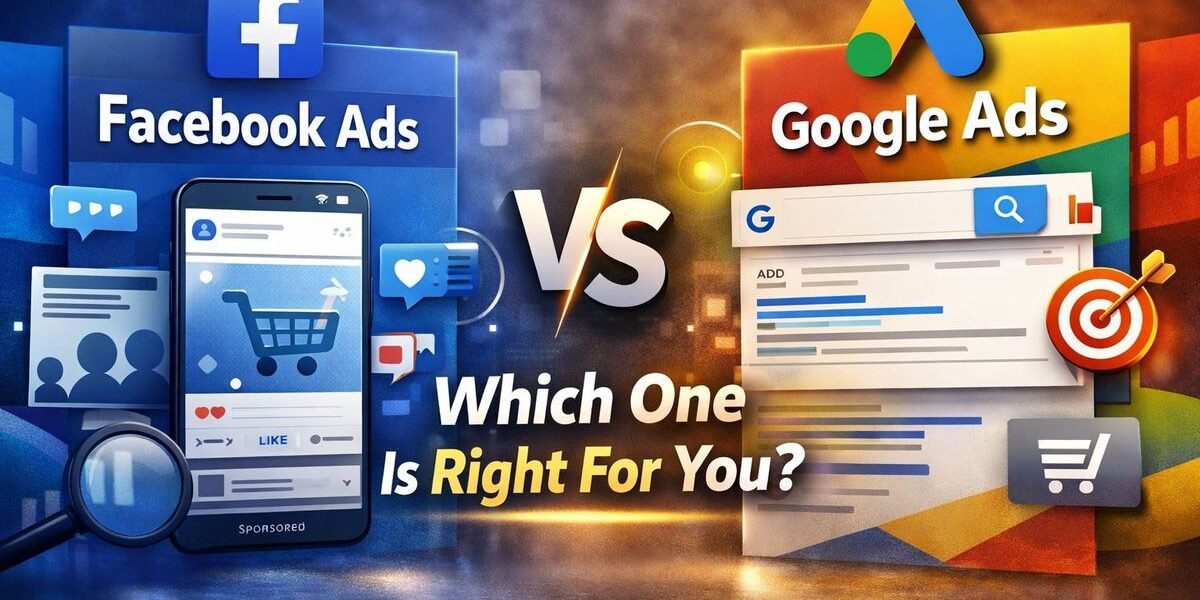
Choosing between Google Ads and Facebook Ads comes down to one question: are you reaching people who are actively searching, or people who don’t know they need you yet? Google Ads captures existing demand. Facebook Ads creates it. That single distinction shapes your budget, your creative, and your results.
Both platforms run on pay-per-click (PPC) advertising — a model where you pay each time someone clicks your ad. But they serve different moments in the buying journey. If someone types “emergency plumber near me” into Google, they want help now. If someone scrolls past a stylish water bottle on Facebook, they weren’t looking for one — the ad planted the idea. Understanding this gap is the fastest way to spend your ad dollars wisely. For a broader look at how paid campaigns fit into a full growth plan, the team at Gettopeaks breaks down these strategies in plain terms.
Quick Answer: Google Ads vs Facebook Ads
Neither platform is universally better. Google Ads works best for capturing high-intent demand — people searching for a specific product or service. Facebook Ads works best for building awareness and reaching people based on interests, demographics, and behavior before they search. The right choice depends on your goal, your audience, your product, and your budget. Many businesses get the strongest results by using both.
What Are Google Ads?
Google Ads is Google’s paid advertising platform, where you bid to show ads to people searching on Google and across its network. It runs on keywords — the words and phrases people type into search. When someone searches a term you’ve bid on, your ad can appear above or below the organic results.
The core format is the Search Ad: a text ad triggered by search intent (the reason behind a query). This is what makes Google powerful. You reach people at the exact moment they want a solution. Search “tax accountant Chicago” and the ads you see are competing for a ready-to-act customer.
Google Ads also includes other formats:
- Shopping Ads — product listings with images and prices, ideal for ecommerce.
- Display Ads — visual banners shown across millions of partner websites.
- YouTube Ads — video placements on the world’s second-largest search engine.
- Performance Max — campaigns that run across all Google inventory automatically.
You pay when someone clicks, and your cost depends on competition for each keyword. To see how bidding and quality scores work, review Google’s official Google Ads Help Center.
What Are Facebook Ads?
Facebook Ads is Meta’s advertising platform, which places ads across Facebook, Instagram, Messenger, and the Audience Network. It’s the largest paid social channel — advertising that appears in social feeds rather than search results. You don’t target keywords here. You target people.
Meta’s strength is audience targeting: reaching users based on demographics (age, location, gender), interests (hobbies, pages they follow), and behaviors (purchase patterns, device use). You can also build custom audiences from your customer list and use remarketing — showing ads to people who already visited your site or engaged with your brand.
Because Facebook reaches people while they browse, not search, it excels at demand generation. A handmade candle brand can put a scroll-stopping video in front of people who love home décor — customers who never would have searched “soy candle.” That’s the difference: Facebook introduces you before the need becomes a search. Learn more from Meta’s official Meta Business Help Center.
Google Ads vs Facebook Ads: Key Differences
The biggest difference is intent: Google captures active demand, while Facebook builds interest. Everything else — cost, creative, targeting — flows from that. Here’s how the two compare across the factors that matter most.
| Factor | Google Ads | Facebook Ads |
| User intent | High — people actively searching | Low to medium — people browsing |
| Targeting basis | Keywords and search queries | Interests, demographics, behaviors |
| Best objective | Lead generation, direct sales | Awareness, discovery, engagement |
| Ad format | Mostly text; Shopping and video | Highly visual — image and video |
| Conversion potential | Strong for ready-to-buy users | Strong when nurtured over time |
| Brand awareness | Limited on Search; strong on Display/YouTube | Excellent |
| Remarketing | Available across network | Highly refined and visual |
| Speed to customers | Fast for high-intent searches | Fast for reach; slower for conversions |
| Measurement | Clear conversion tracking | Strong, with attribution nuances |
Read each row as a decision point, not a scorecard. A row that favors Google for one business may favor Facebook for another.
Which Is More Cost-Effective?
There is no fixed price or guaranteed cheaper platform — cost depends entirely on your industry, competition, and campaign quality. A single keyword click can cost under a dollar in a low-competition niche or over $50 in fields like legal and insurance. Facebook clicks are often cheaper, but a cheap click means nothing if it doesn’t convert.
Real cost-effectiveness is measured by ROAS (return on ad spend) — the revenue you earn for every dollar spent. Several factors move that number:
- Match your keywords or audience tightly to your offer. Broad targeting wastes budget on the wrong people.
- Improve ad quality and relevance. Google rewards relevant ads with lower costs; Meta rewards engaging creative.
- Optimize your landing page experience. A slow or confusing page kills conversions no matter how good the ad is.
- Track conversions accurately. Without conversion tracking, you’re guessing.
Compare platforms on cost per conversion, not cost per click. That’s the number that reflects profit.
When Should You Use Google Ads?
Use Google Ads when people are actively searching for what you sell. This is the platform for capturing demand that already exists — the highest-intent traffic available in digital advertising.
Google Ads is particularly effective for:
- High-intent searches — “buy running shoes online” or “hire a bookkeeper.”
- Local services — a dentist, electrician, or law firm targeting a specific city.
- Emergency or immediate-need services — locksmiths, HVAC repair, towing.
- Specific product searches — ecommerce stores using Shopping Ads.
- Businesses with a clear search audience — anyone whose customers describe their problem in words.
If your customers Google their problem, start there. Build campaigns around the exact phrases they type.
When Should You Use Facebook Ads?
Use Facebook Ads when you need to build demand, showcase visual products, or reach people by interest rather than search. It’s the platform for discovery — introducing your brand to people who fit your ideal customer but aren’t searching yet.
Facebook and Instagram Ads work well for:
- Brand awareness — putting a new business in front of a defined audience.
- Visually driven products — fashion, food, home goods, fitness.
- Audience discovery — reaching users by interests and demographics.
- Retargeting — reminding site visitors and cart abandoners to return.
- Ecommerce promotions — sales, launches, and limited offers.
- Social engagement — building a community around your brand.
If your product is a “didn’t-know-I-needed-it” purchase, Facebook gives you room to spark that interest with strong visuals.
Can You Use Google Ads and Facebook Ads Together?
Yes — combining both platforms often produces the strongest results, because they cover different stages of the buying journey. Facebook creates awareness; Google captures the demand that awareness produces.
Picture a real path. A skincare startup runs an Instagram video that catches a shopper’s eye. She doesn’t buy yet, but she remembers the name. Two days later she searches “vitamin C serum” on Google — and the brand’s Search Ad appears. The Facebook impression planted the seed; the Google Ad closed the sale. Neither platform gets full credit alone, which is exactly why they work better paired.
Set up conversion tracking across both so you can see how they support each other.
Google Ads vs Facebook Ads for Small Businesses
For small businesses with limited budgets, the priority isn’t picking a “winner” — it’s spending carefully and measuring everything. A tight budget punishes wasted clicks, so setup discipline matters more than platform choice.
Before you scale spend, put these foundations in place:
- Define a clear conversion goal. A phone call, form fill, or purchase — know what success looks like.
- Build a focused landing page. Send traffic to a page that matches the ad, loads fast, and works on mobile.
- Research your audience or keywords. Understand what your customers search for and care about.
- Install conversion tracking. Use Google Analytics and the Meta Pixel to measure real results.
- Test small, then scale. Start with a modest budget, learn what converts, and increase spend on winners.
Start with the platform that matches your customer’s behavior, prove it works, then expand. For guidance on setting up tracking correctly, see Google’s Analytics Help Center.
How to Choose Between Google Ads and Facebook Ads
Choose your platform by matching it to your business situation, not to a general rule. Work through this framework and let your answers point the way.
- Business objective — Direct sales or leads? Lean Google. Awareness? Lean Facebook.
- Customer intent — Are people searching for you, or would they discover you? Search favors Google.
- Product or service type — Visual and impulse-friendly favors Facebook; solution-driven favors Google.
- Sales cycle — Short and urgent suits Google; longer nurture suits Facebook.
- Budget — Limited budgets should start where intent is highest for faster returns.
- Target audience — Definable by interests? Facebook. Definable by search terms? Google.
- Creative assets — Strong photos and video make Facebook far more effective.
- Conversion tracking — Whichever you choose, measure it from day one.
Answer these eight questions, and the right starting platform usually becomes obvious.
Frequently Asked Questions
Is Google Ads better than Facebook Ads?
Neither is better overall. Google Ads wins for high-intent, search-driven demand; Facebook Ads wins for awareness and interest-based targeting.
Is Facebook Ads cheaper than Google Ads?
Facebook often has a lower cost per click, but cheaper clicks don’t guarantee cheaper conversions. Compare cost per conversion instead.
Which is better for small businesses?
The one that matches your customer’s behavior. Service businesses with searching customers often start with Google; visual brands often start with Facebook.
Which platform is better for lead generation?
Google Ads typically generates higher-intent leads from search, while Facebook Ads can produce a higher volume of leads at a lower upfront cost.
Which is better for ecommerce?
Both perform well. Google Shopping captures buyers ready to purchase; Facebook and Instagram drive discovery and retargeting for visual products.
Can I run Google Ads and Facebook Ads at the same time?
Yes. Running both lets you build demand on Facebook and capture it on Google, covering more of the buying journey.
How much should a business spend on paid advertising?
There’s no universal figure. Start with a budget you can test for at least a few weeks, track conversions, and scale spend on what proves profitable.
Put Your Ad Budget to Work
The smartest advertising decision isn’t Google or Facebook — it’s building a strategy around how your customers actually behave, then measuring what works. That takes clear goals, tight targeting, and honest tracking. If you’d rather focus on running your business than managing campaigns, the digital marketing specialists at Gettopeaks can help you plan, launch, and optimize campaigns across both platforms. Reach out to Gettopeaks today and take the next step toward advertising that’s built on strategy, not guesswork.