

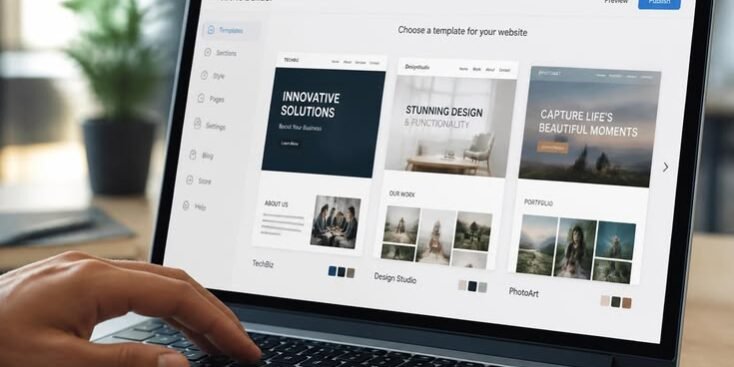
Your customers check you online before they call, visit, or buy. If they can’t find a professional website, many of them move on to a competitor who has one. That single moment decides whether you win the lead or lose it.
A strong business website works around the clock. It answers questions, builds trust, and turns curious visitors into paying customers while you sleep. But not every website does this well. The difference comes down to design, speed, security, and how clearly you guide people toward action.
This guide walks you through what a business website is, why you need one, and what makes it effective. If building or upgrading one feels overwhelming, a professional team offering WordPress development, Shopify development, SEO, and content writing can handle the technical work so you stay focused on running your business. Below, you’ll get practical answers, real examples, and clear next steps.
What is a business website?
A business website is a collection of connected web pages that represents your company online. It serves as your digital storefront — the place where customers learn who you are, what you offer, and how to reach you.
Most business websites include a few core pages: a homepage, an about page, a services or products page, and a contact page. Larger businesses add blogs, booking tools, or online stores.
Think of it as your most reliable employee. It never takes a day off, and it speaks to hundreds of visitors at once. A restaurant uses its site to show the menu and take reservations. A law firm uses one to explain services and collect case inquiries.
Your next step: List the three most important actions you want visitors to take on your site.
Why does a business need a website?
A business needs a website because customers expect one. According to a 2023 survey by Top Design Firms, 71% of small businesses have a website, and most consumers research online before making a purchase.
Without a site, you hand that traffic to competitors. With one, you control the message, capture leads, and build credibility on your own terms.
Here are the main reasons a professional website matters:
- Credibility: A polished site signals that your business is real, active, and trustworthy.
- Reach: You can attract customers beyond your local area, 24 hours a day.
- Lead generation: Contact forms and calls-to-action turn visitors into inquiries.
- Control: Unlike social media, you own your website and its data.
- Cost efficiency: A website often costs less than repeated print or radio advertising.
Social profiles help, but they belong to the platform — not to you. A website is the one online asset you fully control.
Your next step: Search your business name on Google and see what a potential customer finds first.
What should a business website include?
Every effective business website shares the same foundation. These elements decide whether visitors stay and convert or leave within seconds.
Responsive design that works on every device
Responsive design means your site adjusts automatically to fit phones, tablets, and desktops. Google reports that mobile devices generate more than half of global web traffic, so this is non-negotiable.
Test your site on your own phone. If you have to pinch and zoom, you’re losing customers.
Fast website performance
Website performance is how quickly your pages load and respond. Google found that as page load time goes from one to three seconds, the chance of a bounce increases by 32%.
Compress images, choose reliable hosting, and remove unused plugins. Speed is one of the cheapest ways to keep visitors engaged.
Website security
Website security protects your site and your visitors’ data from attacks. At a minimum, install an SSL certificate — the technology that turns your address into “https” and shows a padlock in the browser.
Secure sites rank better and reassure customers. This matters most when you collect personal information or payments.
Clear navigation
Navigation is the menu system that helps visitors find what they need. Keep it simple: five or six main menu items are usually enough.
Group related pages together and label them in plain language. A confused visitor rarely becomes a customer.
Professional business website design
Business website design covers the visual layout, colors, fonts, and imagery that shape first impressions. Studies from Stanford’s Web Credibility Project show that people judge a company’s trustworthiness largely on design.
Keep it clean and consistent with your brand. White space and readable text beat clutter every time.
Website SEO
Website SEO is the practice of optimizing your pages so search engines can find and rank them. This includes descriptive titles, helpful content, fast loading, and clear structure.
Strong SEO brings free, ongoing traffic. Content you optimize today keeps earning visibility for months.
Calls-to-action that drive conversions
A call-to-action (CTA) is a button or prompt that tells visitors what to do next. “Get a Quote,” “Book Now,” and “Contact Us” are common examples.
Place one clear CTA on every page. Conversions — the actions that turn visitors into leads or customers — depend on it.
Your next step: Audit your homepage against this list and mark which elements are missing.
How a website generates leads, builds credibility, and supports growth
A well-built website does three jobs at once: it captures leads, builds trust, and fuels long-term growth. Each one compounds over time.
Lead generation happens through forms, chat tools, and CTAs. A visitor fills out a contact form, and you gain a warm prospect without spending a dollar on ads.
Credibility grows through testimonials, case studies, and a clear about page. When people see reviews and real results, they feel safe choosing you.
Growth comes from data and reach. Your online presence lets you test offers, track what works, and expand into new markets. A local bakery, for example, can start shipping nationwide once its website supports online orders.
Your next step: Add one testimonial and one lead-capture form to your most visited page.
Common mistakes businesses should avoid
Most underperforming websites fail for the same reasons. Fix these early and you’ll stay ahead of competitors who ignore them.
- Slow loading: Large images and cheap hosting drive visitors away.
- No mobile optimization: A site that breaks on phones loses most of its traffic.
- Unclear messaging: If visitors can’t tell what you do in five seconds, they leave.
- Missing contact details: Hidden phone numbers and forms kill inquiries.
- Ignoring security: No SSL certificate warns visitors that your site is unsafe.
- No clear CTA: A pretty site with no direction generates no conversions.
Your next step: Pick the one mistake above that applies to your site and fix it this week.
How to choose the right website development approach
The right website development approach depends on your budget, timeline, and technical comfort. You have three main options.
- Website builders: Tools like Wix or Squarespace let you build a simple site yourself. Best for tiny budgets and basic needs.
- Content management systems: Platforms like WordPress or Shopify offer flexibility and room to grow. WordPress powers over 40% of all websites, according to W3Techs.
- Professional developers: A dedicated team builds a custom site tuned for performance, SEO, and conversions. Best when your website drives serious revenue.
If your site is central to your income, hire professionals. The investment pays back through better user experience and higher conversions.
Your next step: Match your budget and goals to one of these three paths.
Practical tips for improving an existing website
Improving a website beats rebuilding it in most cases. Small changes often deliver the biggest gains.
- Speed test first: Use Google PageSpeed Insights to find what’s slowing you down.
- Refresh your content: Update outdated pages and add answers to common customer questions.
- Strengthen CTAs: Make buttons visible and action-focused.
- Improve mobile layout: Check that text and buttons work on small screens.
- Add proof: Insert recent reviews, ratings, and case studies to build trust.
Your next step: Run your homepage through Google PageSpeed Insights today and note your score.
Frequently asked questions
How much does a business website cost?
A basic website built on a builder can cost $100–$500 per year. A professional custom site typically ranges from $2,000 to $10,000 or more, depending on features and complexity.
How long does it take to build a business website?
A simple site can go live in a week. A custom website with e-commerce or advanced features usually takes four to twelve weeks.
Do I need a website if I have social media?
Yes. Social media reaches people, but you don’t own those platforms. A website gives you full control over your content, data, and customer experience.
What makes a business website successful?
A successful business website loads fast, works on mobile, ranks in search, builds trust, and guides visitors toward a clear action. Success shows up in conversions, not just visits.
Take the next step toward a stronger website
A business website is one of the highest-return investments you can make. It works every hour, builds credibility, and turns visitors into customers — but only when design, speed, security, and clear CTAs come together.
Start with one improvement today. Test your speed, fix your mobile layout, or add a lead form. Each change moves you closer to a site that earns its keep.
If you’d rather have experts handle the build, the Top Peaks team offers WordPress and Shopify development, SEO, graphic design, content writing, and social presence to create a website tuned for real results. Reach out, share your goals, and get a website that works as hard as you do.